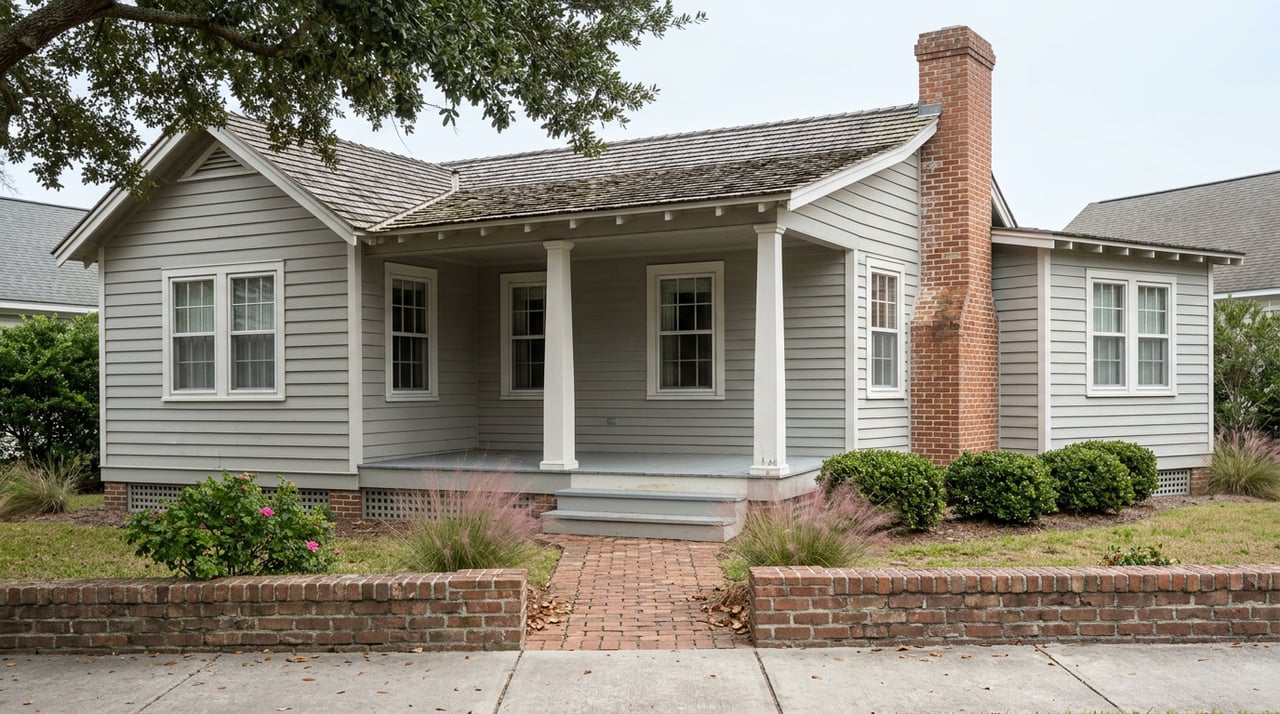
Two units in the same Virginia Beach building can look identical on paper. Same square footage, same floor, same ocean view. One can legally take Airbnb bookings every week of the summer. The other cannot, and no amount of renovation or staging changes that. The difference isn't the unit. It's which side of a boundary line the city is currently redrawing.
That line runs through the Oceanfront Resort Short-Term Rental Overlay District, and as of August 2026 it's in the middle of the biggest revision it has seen in years. If you're shopping for a condo or house at the Oceanfront with rental income in mind, the boundary matters more than almost anything else on the listing sheet.
Two Overlays, Two Very Different Rulebooks
Virginia Beach doesn't have one short-term rental system. It has two, and they work differently enough that a buyer moving between them needs to reset expectations entirely.
In the Sandbridge Special Service District, short-term rentals are allowed by right. An owner still has to register annually with the Commissioner of the Revenue and pull an annual zoning permit, but there's no Conditional Use Permit standing between a purchase and a booking calendar.
The Oceanfront Resort Overlay works differently. New short-term rentals there need a Conditional Use Permit approved by City Council, on top of the same annual zoning permit, and that CUP has to be renewed every five years. A buyer who assumes Oceanfront rules mirror Sandbridge rules is working from the wrong rulebook.
| Oceanfront Resort Overlay | Sandbridge Special Service District | |
|---|---|---|
| How you get in | Conditional Use Permit plus annual zoning permit | Annual zoning permit only |
| CUP renewal | Every five years | Not applicable |
| Registration proof at permit time | Copy of Commissioner of the Revenue receipt required | Registration still mandatory, but proof isn't required at permit time |
| Annual zoning permit fee | $500 | $500 |
| Liability insurance | At least $1 million, naming the property address | Same requirement |
Both districts require that $1 million liability policy, and in both cases a standard landlord policy typically won't cover it. Short-term rental activity is usually excluded outright from ordinary Virginia landlord insurance, which means an owner needs a home-sharing endorsement or a dedicated short-term rental policy, plus coverage for guest injuries and alcohol-related incidents. Coastal wind exposure adds another layer of underwriting on top of that. None of this shows up in a listing description, but it shows up in the first-year operating budget.
The Line Just Moved, and It Can Move Again
City Council referred a review of the Oceanfront overlay after mounting concern about rental proliferation, parking strain, and pressure on the local housing supply. Staff floated a map earlier this year that would have pulled the permitted boundary back sharply, landward toward roughly 18th Street, pulling away from North Birdneck Road and excluding the Resort Beach neighborhood, Atlantic Park, and the areas around the convention and sports center entirely.
That version drew enough pushback from property owners, brokers, and the Hampton Roads Realtors Association that the Planning Commission asked for more outreach before acting. What came back was a second option, known as Alternative A, which keeps the ViBe District and adjacent blocks inside the overlay rather than cutting them out.
On August 12, 2026, the Planning Commission voted 11 to 0 to recommend Alternative A, along with a companion ordinance updating how grandfathering works. Zoning administrator Hannah Sabo explained the mechanics to commissioners plainly.
"Legally operating short-term rentals that are mapped out of the overlay would become grandfathered."
That recommendation now goes to City Council, which will decide whether to adopt Alternative A as the new boundary. The point for a buyer isn't which map wins. It's that the boundary has already shifted once this year under public pressure, and the body with final say hasn't voted yet. A property that sits comfortably inside the overlay today isn't guaranteed to sit there under the next revision, whether that comes this year or a few years from now.
What Grandfathering Protects, and What It Doesn't
If a property gets mapped outside the adopted overlay, it doesn't automatically lose its rental status. A legally operating short-term rental in that position becomes grandfathered, but grandfathering comes with real limits.
A grandfathered property can't expand its dwelling footprint by more than 25 percent or 1,000 square feet, whichever is smaller. And if the owner stops using it as a short-term rental for two consecutive years, the grandfathered status is gone for good. This is the detail that matters most to an investment buyer: a gap year, a slow renovation, or a change in management that leaves the unit dark for two summers can permanently convert an income property back into an ordinary residence in the eyes of the city.
There's also a hard cutoff built into the pending ordinance. Grandfathering under the new rules only applies to properties holding an active Conditional Use Permit issued before September 1, 2026. Staff noted seven pipeline applications caught in that window, six of them in the same building. If a listing agent tells you a CUP is "in process," ask exactly where in that process it stands and whether it cleared before the cutoff. That answer changes the property's long-term rental eligibility, not just its paperwork.
The Parking Rule Inside the Zoning Change
The same package moving through City Council also ends a practice that some Oceanfront rental owners have relied on for years: leasing spaces in city-owned parking garages to satisfy the one-space-per-bedroom requirement. Currently, 29 short-term rentals lease 76 spaces across two Oceanfront garages. Those existing arrangements would continue as a carve-out if the changes are adopted, but no new garage leases would be permitted going forward.
For a buyer, this matters most on properties without dedicated on-site parking, which describes a fair number of older Oceanfront buildings. A unit's rental math can look fine until you check whether its parking plan depends on a garage lease arrangement that new buyers won't be able to replicate.
The Deck Inspection Isn't a Formality
Virginia Beach requires structural safety reports on short-term rental decks, generally every three years, or annually if the property isn't under professional management. The requirement traces back to two deck collapses on Sandfiddler Road in Sandbridge in the summer of 2020, months apart, both sending people to the hospital. The city tightened its rules in response, and those structural and life-safety inspection requirements now sit alongside the zoning permit as a condition of legal operation in both overlay districts.
For a buyer, this means the home inspection you'd normally order isn't a substitute for the STR-specific structural report the city requires. If a seller can't produce a current one, budget time and money for it before you count on rental income from day one.
Before You Write an Offer
None of this is visible from a listing photo or a property's address alone. Before making an offer on anything at the Oceanfront with rental income built into your numbers, get specific answers on four things: whether the property currently holds an active CUP and when it was issued, whether it falls inside the existing overlay or would rely on grandfathered status if Alternative A is adopted, whether its parking plan depends on a garage lease that can't be renewed for a new owner, and whether its current structural safety report is up to date.
The city's Planning Department maintains the current overlay map and permit information, and it's worth checking a specific address against it before you get attached to the numbers a listing sheet implies.
Buying at the Oceanfront with rental income in the plan means buying the zoning status as much as the unit itself. That status is genuinely in motion right now, and the properties that come out ahead of the next map revision will be the ones whose owners understood exactly where the line sat, and where it was heading, before they signed.
If you're weighing an Oceanfront or Sandbridge property with rental income in the plan, Conner & Company can help you check a specific address against the current overlay boundary and permit history before you write an offer.